
Why your brain still has a "loading screen" when you speak i…
페이지 정보


'Do you have a "loading screen" in your brain?'
Someone asks you a simple question in English. You know the answer. But first, you hear the sentence in your native language. Then, your brain frantically searches its database for the English words. Finally, you construct the grammar equation and speak.
By then, the moment has passed. There is awkward silence.
This is the "Translation Lag." It’s the biggest barrier to fluency, and it happens because of one fundamental mistake: You are still treating English like a school subject.
Here is how to switch your brain’s operating system from "Studying Mode" to "Living Mode."
✨ Vocabulary Notes
Frantically (adverb): Doing something in a very hurried and stressed way.
Construct (verb): To build, make, or put together (like building a house or a sentence).
Lag (noun): A delay; the time between an action and its result.
1. The "Math Class" Mistake
For most of us, our first experience with English was in a classroom. We learned it the same way we learned history or mathematics: Memorize facts (vocabulary), learn rules (grammar equations), and take tests.
In this system, English is useless data until you need it for an exam. Your brain naturally stores it in the "academic" compartment, separate from your "real life" compartment.
But language is not math. It’s not about getting the right answer. It’s a tool for connection, like a telephone or a bicycle. You cannot learn to ride a bicycle by reading a physics textbook about balance. You have to get on the bike and wobble.
✨Vocabulary Notes
Compartment (noun): A separate section or box for keeping things organized.
Wobble (verb): To move unsteadily from side to side; to shake because you are not balanced.
2. The Shift: From "Learning to Use" to "Using to Learn"
Fluent speakers don't have a better memory than you. They just have a different relationship with the language.
The Student Mindset: "I need to study more vocabulary before I am ready to have a conversation." (Learning to use)
The Living Mindset: "I want to make a new friend, so I will use whatever English I have right now to connect with them." (Using to learn)
Fluency doesn't happen before you start living in English. It happens while you are living in English. You need to stop waiting for perfection and start using the tool—even if you use it clumsily at first.
✨Vocabulary Notes
Mindset (noun): A person's way of thinking and their opinions.
Clumsily (adverb): Moving or doing things in an awkward way; without skill.
3. How to Break the Translation Habit
You can't just command your brain to "think in English." You have to change your environment.
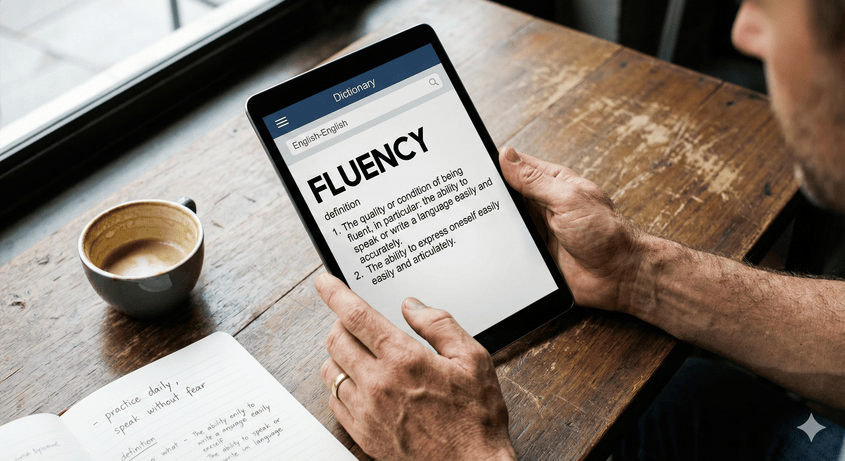
A. The Monolingual Shift (Ditch the bilingual dictionary) When you see an unknown English word, stop translating it back to your native language. Use an English-English dictionary. Force your brain to define English concepts using other English concepts. This builds direct neural pathways.
B. Narrate Your Life (The "Shower Talk") When you are alone—cooking, showering, or driving—narrate what you are doing in English. "I am chopping onions. The water is boiling. I feel tired today." This trains your brain to connect your immediate physical reality directly to English words, bypassing your native language.
✨Vocabulary Notes
Monolingual (adjective): Using or speaking only one language.
Neural pathways (noun): Roads in your brain that help information travel fast.
Narrate (verb): To tell a story or describe what is happening while it happens.
Bypass (verb): To go around something; to skip a step.
Conclusion
Fluency is not a final exam score you achieve someday. It is a lifestyle choice you make today.
If you keep treating English like a textbook to be studied, it will always remain external to you. To make it yours, you must invite it into your real life.
Are you ready to stop studying and start living?
You don't need another lecture. You need a real environment. Langclub is where you stop being a "student" and start being a "user" of English, connecting with real people around the world.
✨Vocabulary Notes
External (adjective): Coming from outside; not a part of you.